
Choosing the right garage door type can feel like a small decision, until you realise it affects your home’s security, comfort, and curb appeal for decades.
In Auckland’s unique coastal and suburban mix, weather exposure, available space, and insulation potential all play a big role in what works best.
This guide compares sectional, roller, and tilt garage doors across cost, design, maintenance, and performance, helping you decide which option fits your home and lifestyle.
If you’re planning a replacement or upgrade, you can book a free measure and quote.
Before comparing features, it helps to know how each system works and where it performs best.
Sectional doors are made of horizontal panels that rise vertically and curve onto tracks overhead.
They are the most popular style across Auckland because they’re quiet, durable, and offer excellent sealing against wind and moisture.
How they work:
Panels are hinged together and move on rollers along a track that bends near the ceiling.
Most modern models are compatible with insulation and automation systems.
Ideal for:
See examples in the Sectional Door Range.
A roller door uses a single corrugated steel curtain that coils around a drum above the opening.
This design saves internal ceiling space and is particularly useful for smaller garages or those with minimal headroom.
How they work:
The curtain rolls up vertically into a compact cylinder, leaving the ceiling clear for storage or lighting.
Ideal for:
View models in the Roller Door Range.
A tilt door operates as a single solid panel that swings outward and upward in one piece.
This classic design suits older villas or homes where modern sectional tracks can’t be installed due to framing constraints.
How they work:
Hinges and counterbalance arms lift the panel outward before it slides under the ceiling.
Ideal for:
Explore options in the Tilt Door Range.
|
Door Type |
Average Installed Cost (NZD) |
Maintenance Level |
Insulation Potential |
|
Roller |
$1,800 – $3,000 |
Low |
Limited |
|
Sectional |
$2,500 – $6,000 |
Moderate |
High |
|
Tilt |
$2,200 – $4,000 |
Moderate–High |
Low–Moderate |
Sectional doors sit mid-to-high in upfront cost but deliver the best long-term comfort and energy performance.
Roller doors remain the most affordable, while tilt doors fall between the two depending on material and design.
For more detailed pricing, see Garage Door Installation Costs in Auckland.
Auckland homes vary widely, from tight inner-city carports to large suburban garages.
The amount of headroom (space between the lintel and ceiling) often determines which type you can install.
|
Door Type |
Headroom Needed |
Best Fit |
|
Roller |
300–400 mm |
Compact garages, low ceilings |
|
Sectional |
200–300 mm |
Most modern homes |
|
Tilt |
150–250 mm |
Villas or limited space but requires outward clearance |
Sectional doors need slightly more overhead room for the tracks, while tilt doors need forward clearance in the driveway when opening.
If space is tight, a roller door may be the easiest solution, but you’ll trade off insulation and design flexibility.
Auckland’s combination of humidity, salt air, and rainfall makes corrosion resistance and sealing key performance factors.
Sectional doors
Roller doors
Tilt doors
To maintain any metal door in top condition, rinse surfaces every few months with fresh water and mild detergent, especially within 5 km of the ocean.
Building.govt.nz recommends regular inspections of weather seals and fixings for coastal dwellings.
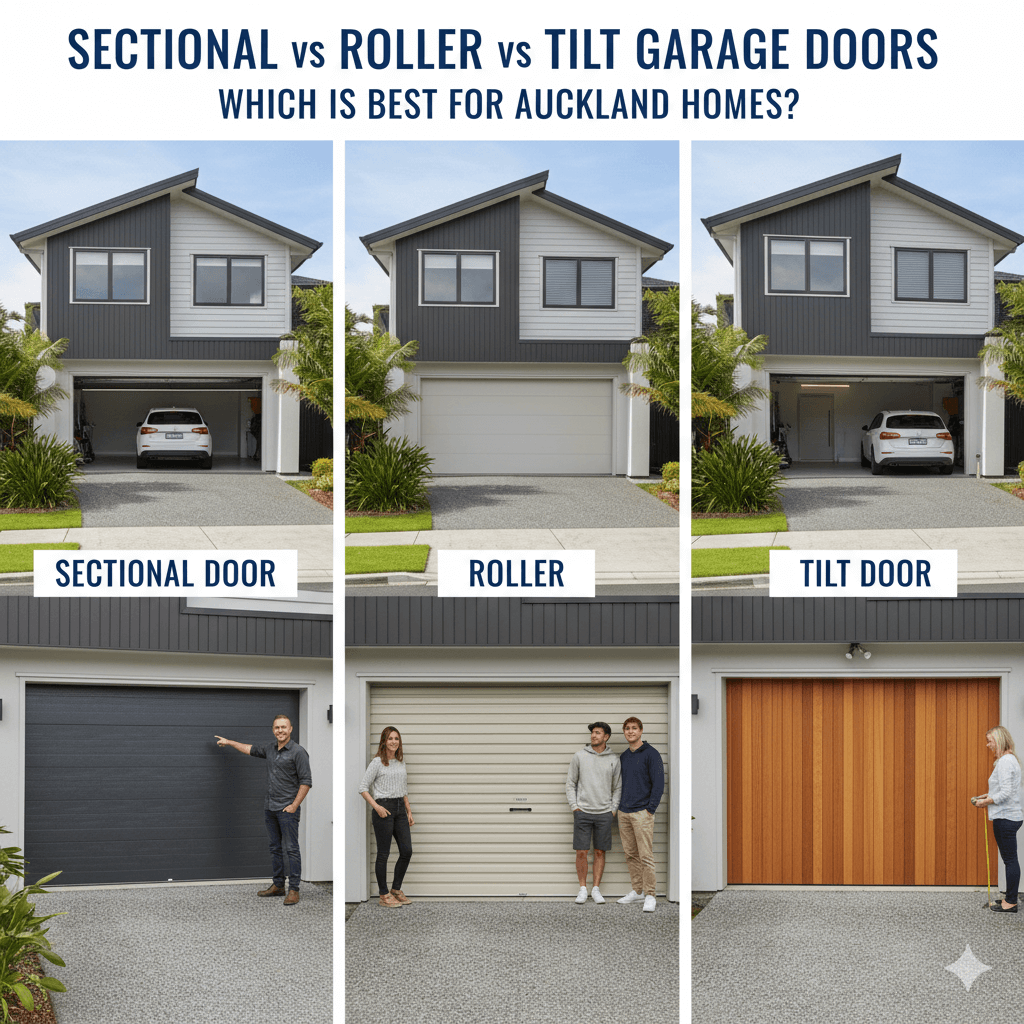
Sectional doors win in terms of design variety.
They’re available in contemporary Flat Smooth, Ribline, or Panoramic Glass styles.
They can also be finished in timber, ColorSteel®, or powder-coated aluminium.
Roller doors offer fewer looks, typically limited to ribbed steel profiles, while tilt doors allow full timber panels or custom flush-mount designs for heritage properties.
For example, the Cedar Door Range pairs perfectly with Auckland’s older villas and bungalows.
If curb appeal is important to you, sectional or tilt doors deliver the best visual impact.
Insulation is where sectional doors clearly outperform the others.
Their multi-panel construction supports double-skin insulated designs that reduce heat transfer, noise, and condensation.
In contrast, roller and tilt doors generally use single-skin steel panels with minimal thermal resistance.
Adding insulation can improve comfort in attached garages and cut household heat loss by up to 20 percent according to the EECA.
Learn more in our Garage Door Insulation Guide.
All three door types can be automated, but sectional and roller doors integrate most easily with modern smart systems.
Sectional and Roller Doors:
Compatible with Merlin MyQ smart openers, allowing remote operation, activity tracking, and secure access sharing.
Both can include automatic locking mechanisms for added protection.
Tilt Doors:
Can be motorised but require special pivot brackets and have limited smart-technology compatibility.
For the highest security, look for automatic deadlock features and rolling-code transmitters that prevent signal copying.
Check with your installer to ensure compliance with Building Code Clause B2 for durability standards.
|
Door Type |
Expected Lifespan (Auckland) |
Maintenance Needs |
|
Sectional |
20–30 years |
Annual service recommended |
|
Roller |
15–25 years |
Low maintenance; occasional lubrication |
|
Tilt |
10–20 years |
Repainting and hinge checks required |
Sectional doors may cost more initially but tend to last the longest, especially when insulated or made from aluminium.
Roller doors win on simplicity, while tilt doors need more frequent maintenance to stay balanced and corrosion-free.
Visit the Garage Door Repairs page for maintenance schedules and tune-up pricing.
If you’re unsure, our technicians can assess your space and recommend the best configuration.
Start by requesting a free on-site quote.
Whether you need a simple roller door, a premium insulated sectional door, or a custom architectural solution, we'll help you understand exactly what factors affect your investment—and how to get the best value.
Call 021 764 609 or email info.doorcompany@gmail.com today.
Let's discuss your garage door project and find the perfect solution within your budget.
SEO By 