
Insulated garage doors noise reduction is a key benefit for homeowners looking to create a quieter environment. These doors can significantly reduce the amount of street noise that enters a garage and nearby living areas. By adding mass, rigidity, and sound-absorbing material to the door structure, insulation helps limit vibration and dampen external noise before it travels into the home.
For Auckland properties located near busy roads, shared driveways, or higher-density housing, this noise reduction can noticeably improve daily comfort—especially in homes with internal access garages.
Garages often act as a weak point in a home’s acoustic barrier.
This is because:
When external noise reaches the garage, it can pass through the door, reflect off hard surfaces inside, and then move into the house through internal access points.
Insulation reduces noise in several ways at once.
They:
Instead of sound passing straight through a thin metal surface, it is partially absorbed and dispersed within the door structure itself.
This combination is far more effective than relying on sealing alone.
Not all noise behaves the same way.
Street noise usually enters garages in two forms:
Non-insulated garage doors tend to transmit both forms easily. The metal surface vibrates and acts like a speaker, amplifying sound inside the garage.
Insulated doors reduce this effect by stiffening the panel and absorbing vibration before it spreads.
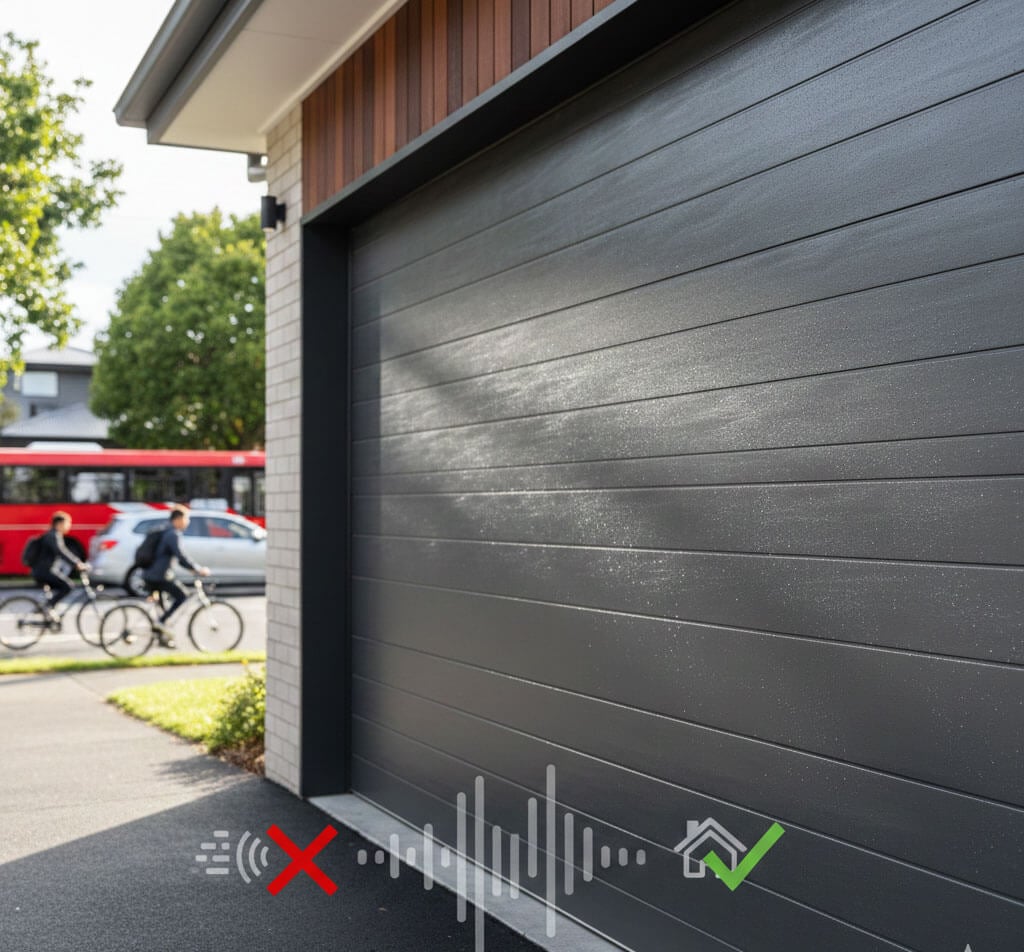
While insulation plays a major role, sealing is still important.
Gaps around a garage door allow noise to bypass the door panel entirely. Insulated garage doors are often paired with better perimeter seals, which helps:
This is one reason insulated doors are commonly combined with sectional garage door systems, which naturally seal more effectively than many other door types.
Noise from the street doesn’t always stop at the garage.
In homes with internal access garages:
Insulated garage doors help by reducing the amount of noise that reaches the garage in the first place, lowering what can transfer into the home.
This is especially valuable when bedrooms, living rooms, or home offices sit above or beside the garage.
Auckland’s urban environment introduces several noise challenges:
In coastal areas, wind can also cause thin garage doors to vibrate, creating additional noise even when the door isn’t being used.
Insulated garage doors are better suited to these conditions because their added rigidity reduces movement caused by wind and pressure changes.
It’s important to have realistic expectations.
Insulated garage doors:
They do not:
They are best viewed as part of a broader noise-control strategy rather than a standalone solution.
Homeowners often notice garage-related noise issues when:
If these signs are present, the garage door is often a contributing factor.
| Feature | Insulated Garage Door | Non-Insulated Garage Door |
|---|---|---|
| Panel construction | Thicker, rigid panels with insulation core | Thin single-skin metal |
| Vibration control | Reduced vibration and panel movement | More prone to rattling |
| Sound absorption | Absorbs and dampens noise | Minimal sound absorption |
| Internal comfort | Quieter garage and reduced noise transfer | More external noise reaches the home |
To get the best results from an insulated garage door:
These steps help preserve the noise-reducing benefits over time.
Street noise is a common issue for Auckland homes, particularly in busy or built-up areas. Insulated garage doors help reduce how much of that noise enters the garage and the home by adding mass, absorbing vibration, and improving sealing.
While they won’t create complete silence, insulated garage doors can make a noticeable difference to everyday comfort—especially in homes with internal access garages.
Whether you need a simple roller door, a premium insulated sectional door, or a custom architectural solution, we'll help you understand exactly what factors affect your investment—and how to get the best value.
Call 021 764 609 or email info.doorcompany@gmail.com today.
Let's discuss your garage door project and find the perfect solution within your budget.
SEO By 