
If your garage feels like an oven in summer or a fridge in winter, insulation could be the missing link.
For many New Zealand homeowners, especially those in Auckland’s damp, coastal climate, an insulated garage door improves comfort, cuts energy loss, and reduces condensation that can damage tools, cars, and plasterboard.
This guide explains how garage door insulation works, what materials are available in NZ, how much it costs, and which option offers the best performance for your home.
You can book a free quote or assessment through the Garage Door Insulation Service page.
Most garages in New Zealand are built without insulation, yet they often connect directly to living spaces.
An uninsulated door can make attached rooms up to 10–12°C colder in winter and trap heat during summer.
Insulating the door creates a more stable internal temperature, reducing the workload on heat pumps and improving comfort.
In Auckland’s high-humidity environment, insulation also helps prevent condensation, which forms when warm indoor air meets the cold metal surface of a garage door.
Condensation isn’t just cosmetic, over time it can cause mould, rust, and warping of stored items.
According to the Energy Efficiency & Conservation Authority (EECA), improving the thermal envelope of connected garages can cut household heat loss by up to 20 percent.
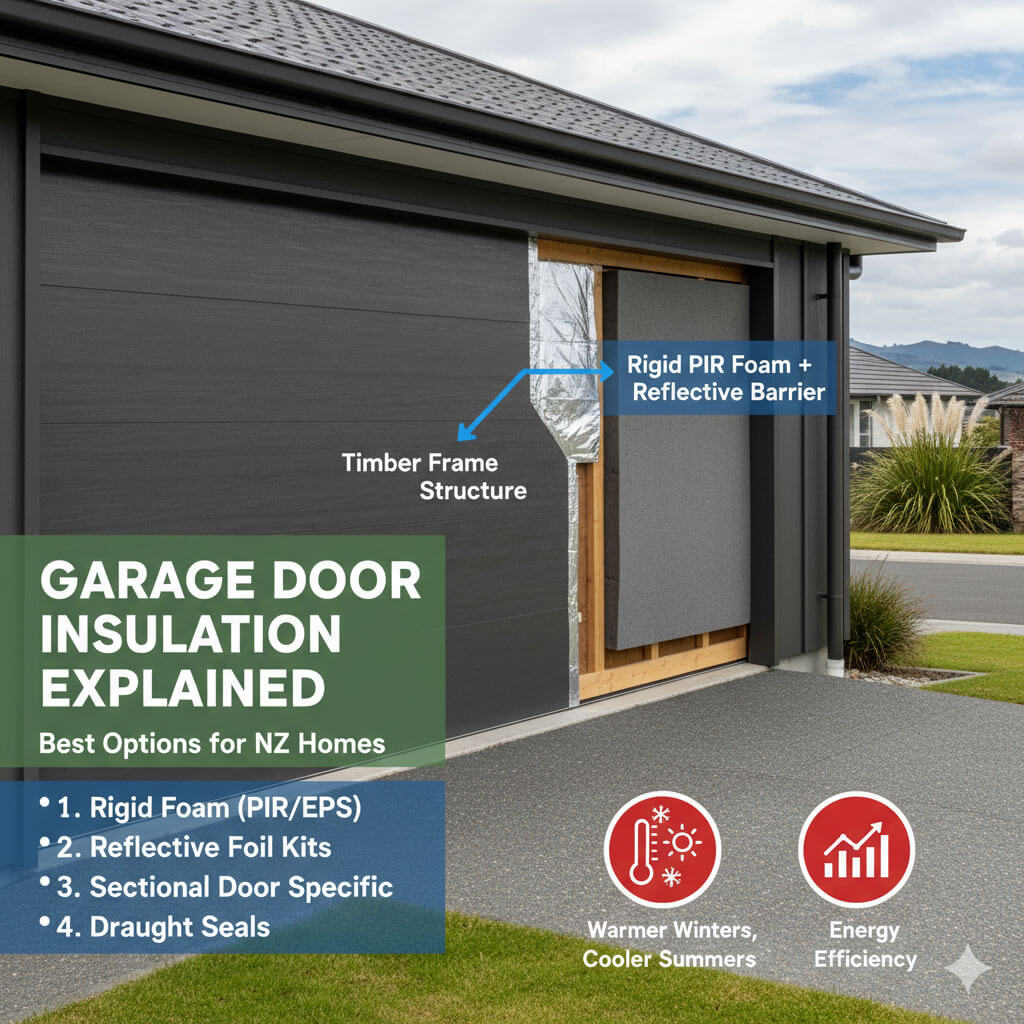
Garage door insulation adds a layer of thermal resistance between the outdoor air and the garage interior.
The material is typically sandwiched between two steel skins (double-skin construction) or fixed to the inside of single-skin doors.
This layer slows the transfer of heat, keeping the space warmer in winter and cooler in summer.
Insulated panels also dampen vibration and noise, a noticeable improvement if your garage sits beneath a bedroom or shares a wall with living areas.
You’ll often see insulation performance expressed as an R-value.
Higher R-values mean better thermal resistance, but they’re only part of the picture, correct sealing and installation are equally important.
An insulated door maintains a more consistent indoor temperature.
Even if you don’t heat your garage, it will feel noticeably warmer in winter mornings and cooler on hot days.
Auckland’s average humidity sits around 80 percent, and uninsulated metal panels quickly become cold enough to form surface condensation.
Insulation stabilises interior temperatures, minimising moisture build-up and mould.
Insulated panels absorb vibration and reduce rattling during opening and closing.
Many homeowners notice up to a 30 percent reduction in noise, especially with sectional doors and Merlin openers.
When garages are attached to the home, they act as thermal bridges.
Insulated doors help maintain the internal temperature, lowering energy use for heating or cooling.
Insulated doors are viewed as premium upgrades.
Buyers increasingly prioritise energy efficiency and comfort, making this a worthwhile investment before resale.
A dense, injected foam that expands into the cavity between door skins.
Rigid sheets inserted behind each door panel.
A DIY-style option that reflects radiant heat.
The most effective systems combine insulation with a double-skin steel structure, available in The Garage Door Company’s Insulated Door Range.
Adding insulation during installation generally costs $400–$1,200 extra, depending on door size and material.
Retrofitting existing single-skin doors can be slightly higher, as panels need to be modified or replaced.
|
Door Type |
Insulation Option |
Approx. Added Cost (NZD) |
R-Value Range |
|
Single Roller |
EPS panels (retrofit) |
$400 – $600 |
1.2 – 1.5 |
|
Sectional Single |
PU core (factory) |
$600 – $900 |
1.8 – 2.4 |
|
Sectional Double |
PU core (factory) |
$800 – $1,200 |
1.8 – 2.4 |
|
Tilt Door |
EPS sheet |
$450 – $800 |
1.2 – 1.6 |
The price difference often pays for itself through better comfort, quieter performance, and longer panel life.
If you’ve noticed these issues, it may be time to upgrade or retrofit.
See 5 Signs Your Garage Door Needs Better Insulation for more detail.
Even the best insulation can’t perform if air leaks around the edges.
Perimeter and bottom seals should be flexible and intact to prevent drafts.
Adding a simple louvre vent or passive airflow system also helps reduce humidity buildup in coastal climates.
For long-term performance, check seals annually and replace them if cracked or flattened.
You can combine this with a full annual garage door service.
|
Feature |
Insulated Door |
Non-Insulated Door |
|
Thermal performance |
Stable year-round temperature |
Cold in winter, hot in summer |
|
Noise |
Quieter operation |
Louder motor vibration |
|
Condensation |
Minimal |
Frequent |
|
Weight |
Heavier (stronger motor required) |
Lighter |
|
Price |
+$400–$1,200 |
Base cost only |
|
Property value |
Increases resale value |
Neutral impact |
If you regularly use your garage for hobbies, storage, or laundry, an insulated door is almost always worth the investment.
Explore available designs like Flat Embossed, Ribline, or Panoramic panels that support full insulation systems.
A regular service plan helps keep seals effective and prevents energy loss.
You can book a maintenance visit here.
Insulated garage doors don’t just keep the garage comfortable, they can influence the energy efficiency of the whole house.
When garages share walls with living rooms, kitchens, or bedrooms, uninsulated metal panels allow rapid heat transfer.
EECA estimates that properly insulated garages can save up to 10 percent on household heating costs for connected spaces.
This effect is particularly noticeable in single-level homes where the garage sits beside the lounge or internal entryway.
For a custom quote or comparison of insulation options, request a free consultation with The Garage Door Company team.
Whether you need a simple roller door, a premium insulated sectional door, or a custom architectural solution, we'll help you understand exactly what factors affect your investment—and how to get the best value.
Call 021 764 609 or email info.doorcompany@gmail.com today.
Let's discuss your garage door project and find the perfect solution within your budget.
SEO By 